WHO WE ARE?
We cup and select our coffees at the farm together with the producer.
All Roblesabana coffees are specialty coffees: small batches or micro-lots with scores above 83 points according to the Specialty Coffee Association (SCA) scale, based in California, USA. Moreover, our coffees come from a single farm, ensuring full traceability and distinctive flavors.
Our micro-enterprise — certified as an SME by the Ministry of Industry and Commerce of Costa Rica — was founded and is operated by women, promoting the visibility of women throughout the coffee value chain in Costa Rica and around the world.

WHO WE ARE?
We cup and select our coffees at the farm together with the producer.
All Roblesabana coffees are specialty coffees: small batches or micro-lots with scores above 83 points according to the Specialty Coffee Association (SCA) scale, based in California, USA. Moreover, our coffees come from a single farm, ensuring full traceability and distinctive flavors.
Our micro-enterprise — certified as an SME by the Ministry of Industry and Commerce of Costa Rica — was founded and is operated by women, promoting the visibility of women throughout the coffee value chain in Costa Rica and around the world.
TRACEABILITY: SMALL BATCHES OR MICRO-LOTS FROM A SINGLE FARM
At Roblesabana Coffee, we take pride in sourcing our specialty coffees directly from farms in Costa Rica — a true guarantee of traceability.
Through this direct trade model, we connect producers and consumers, shortening the coffee supply chain and reducing costs for the final customer, while paying a fair price for each bag of coffee directly to the producers.
WOMEN IN COFFEE
As coffee lovers and experts, we participate in every step of the production chain of our coffees, ensuring quality control and full traceability.
Inspired by the work and determination of women in the coffee industry, our mission is to promote access to and exchange of knowledge. We actively support the participation of women in coffee production and the pursuit of gender equity.
WHY THE NAME ROBLESABANA?
The Roble de Sabana (Tabebuia rosea) is a magnificent neotropical tree, commonly known in Costa Rica as Roblesabana.
Its intense blooming season runs from February to April in the Central Valley of Costa Rica — the region where coffee cultivation began in the early 19th century. The pink canopy of the Roblesabana tree can often be seen within and along the edges of coffee plantations throughout the Central Valley.
THE COFFEE PARADISE
Costa Rica is truly considered The Coffee Paradise. With a land area of only 51,100 km² (0.03% of the planet’s surface) and 589,000 km² of territorial waters, Costa Rica is one of the 20 countries with the greatest biodiversity in the world. Its geographic position, two coastlines, and volcanic mountain ranges create numerous and varied microclimates that explain this natural richness — both in species and ecosystems. The more than 500,000 species found in this small country represent nearly 5% of all estimated species worldwide. Costa Rica is also one of the oldest democracies in Latin America, enjoying one of the most stable and progressive economies in the region. It has had no army or military forces by law since 1948.
HISTORY OF COFFEE IN COSTA RICA
Coffee production in Costa Rica began in the late 18th century in the Central Valley, which offered ideal soil and climate conditions for coffee cultivation. Arabica coffee was introduced directly from Ethiopia. In the 19th century, the Costa Rican state strongly encouraged coffee production. By 1821, at the time of independence, Costa Ricans had already recognized the value of coffee as an export product — and as an opportunity that allowed farmers to free themselves from the poverty conditions in which they had previously lived. For this reason, Costa Rica’s coffee-growing regions continue to be known for their fair distribution of wealth generated by what we proudly call our golden bean. On the map, you can see the coffee-growing regions where our Roblesabana coffees come from.
In Costa Rica’s Central Valley, coffee is grown between 600-1600m in varied soils and climates. Despite urban growth, the region produces high-quality coffee, mainly Caturra and Catuaí, with some specialty varieties. Processing includes honey, anaerobic, and carbonic maceration, supported by numerous micro-mills.
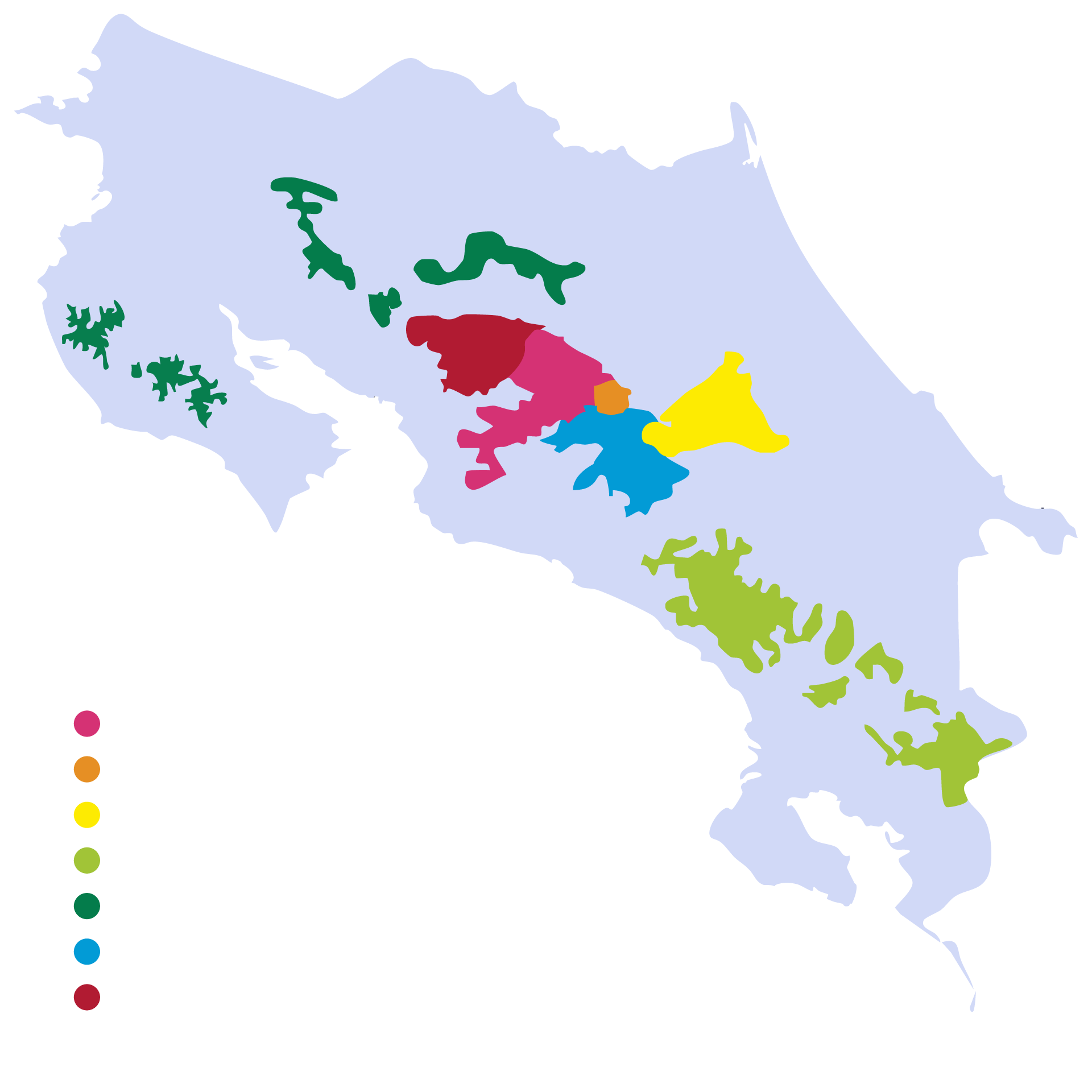
Costa Rica Coffee Regions
CENTRAL VALLEY
Altitude: 20% at 2,952 to 5,249 feet 80% at 3,280 to 4,593 feet. Precipitation: 98 inches. Average temperature: 72°F. Relative humidity: 84%. Harvest: November to February. Soil: Andisol. Shade: Ingas, erythrinae.
This region’s soil has a slight tropical acidity, a result of its enrichment by volcanic ashes. The Central Valley coffee brings a well-balanced cup, cocoa acidity and fruity taste, and body intensity that goes from medium to strong, depending on cultivation altitude.
Our Central Valley Specialty coffees are POAS and Las Lajas Red Honey. In USA, shop our Poas and Las Lajas Red Honey at Amazon.
TRES RIOS
Altitude: 3,937 to 5,413 feet asl. Precipitation: 88 inches. Average temperature: 70°F. Relative humidity: 80%. Harvest: November to March. Soil: Andisol. Shade: Ingas, erythrinae, musaceae, forest trees.
The coffee from Tres Rios has characteristics that remain equally homogeneous throughout the Region. Volcanic soils rich in organic matter and ideal temperatures produce a full-bodied coffee with brown-sugary sweetness and fine acidity, an extraordinary balance which makes it special for strong body coffee lovers.
TURRIALBA
Altitude: 1,640 to 4,593 feet asl. Precipitation: 110 inches. Average temperature: 73°F. Relative humidity: 82%. Harvest: July to March. Soil: Andisol, inceptisol. Shade: Erythrinae, musaceae, forest trees.
The Turrialba coffee has pleasant tasting, a soft and delicate aroma easily comparable to the smell of the ripe fruit of the coffee. It brings a fruity taste and an aftertaste with soft woody notes. Its acidity is barely perceptible, giving full prominence to the sweetness.
BRUNCA
Altitude: 1,968 to 5,577 asl. Precipitation: 138 inches. Average temperature: 72°F. Relative humidity: 85 to 100%. Harvest: August to February. Soil: Andisol, ultisol. Shade: Timber trees, leguminae, fruit trees.
These are coffees from lower and medium altitude areas with very mild taste and a sweet and hints of sugar cane, flowers and citrus fruits. It has a soft aroma with mild acidity, which brings a clean and smooth cup, ideal for light coffee lovers.
NORTH REGION
Altitude: 1,968 to 4,265 feet asl. Precipitation: 138 inches. Average temperature: 79°F. Relative humidity: 70%. Harvest: July to February. Soil: Andisol, Alfisol, Iceptisol. Shade: Ingas, erythrinae, musaceae.
These are coffees from lower and medium altitude areas with very mild taste and a sweet and hints of sugar cane, flowers and citrus fruits. It has a soft aroma with mild acidity, which brings a clean and smooth cup, ideal for light coffee lovers.
TARRAZÚ
Altitude: 3,936 to 6,233 feet asl. Precipitation: 134 inches. Average temperature: 64°F. Relative humidity: 75%. Harvest: November to March. Soil: Ultisol, inceptisol. Shade: Musaceae, erythrinae, fruit trees.
Tarrazu is a coffee growing region that has achieved worldwide fame with its own personal seal. The taste is comparable to fruity flavors like prune, apricot, orange and sometimes even lemon. It has diverse aromas and notes of sweet coffee mucilage, flower blossoms and delicate citric nuances. Its acidity is one of the most outstanding attributes, with an aftertaste of completely ripe coffee cherry.
Try our Tarrazú Coffee, semi-washed process from Montaña farm here.
WEST VALLEY
Altitude: 2,296 to 5,249 feet. Precipitation: 98 inches. Average temperature: 71°F. Relative humidity: 81%. Harvest: October to February. Soil: Andisol. Shade: Ingas, erythrinae, musaceae, fruit trees.
West Valley coffee, which has the most complex flavor of all the regions of the country, is recognized as an excellent full-bodied coffee with sweet and soft aromas like sugar cane, vanilla and dried fruit. Its delicate acidity makes it especially suitable for espresso.
Try our NARANJO Coffee, semi-washed process from Cloza farm here.
What Makes Us Different

COSTA RICAN SPECIALTY COFFEES
Specialty coffee refers to green coffee beans of the highest quality. These beans are roasted by true experts to reach their full flavor potential. All our coffees score 83+ and are 100% produced by women in Costa Rica.

TRACEABILITY
Small batches or micro-lots from a single farm. Direct trade connects producers and consumers, shortens the supply chain, and guarantees fair payment for each bag purchased directly from the producer.

COMMITTED TO SUSTAINABILITY
We work with farms focused on Regenerative Agriculture and low-carbon programs like NAMA Café. Collaboration and quality at every stage ensure long-term sustainability for people, communities, and the planet.

WE ARE WOMEN IN COFFEE
We support women in coffee production and gender equity. As coffee experts, we oversee every step of the process to ensure quality control and full traceability.
FEATURED IN FORBES CENTRAL AMERICA 100 POWERFUL WOMEN 2022
Costa Rican entrepreneur Marcela Porras promotes the work of women in the production and commercialization of specialty roasted coffee, guided by the principle of shared benefit. Marcela Porras is a woman of coffee. She began working in the coffee sector in Costa Rica in 2008 and is the co-founder of Roblesabana, a specialty roasted coffee brand created in 2018 with the purpose of connecting women coffee producers with coffee lovers who aspire to become true connoisseurs.